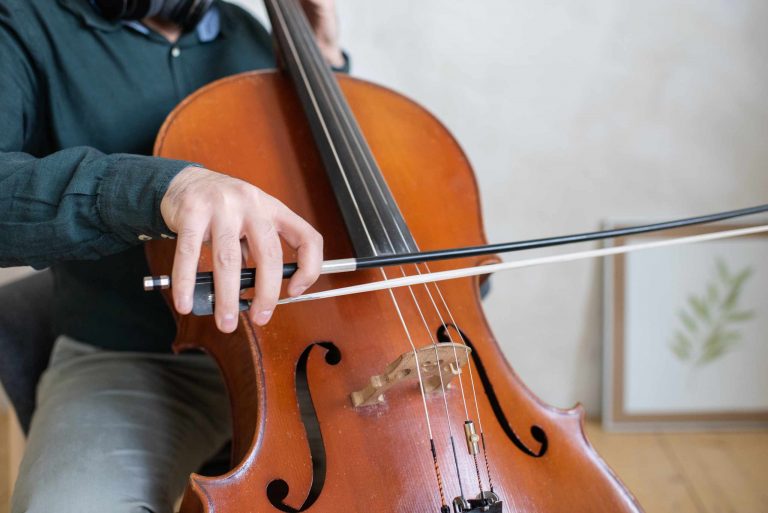
It’s tempting to squeeze the bow and press into the string when you hear a scratchy sound on the cello. However, that often results in increased tension in your bow hand when it needs to stay flexible. Volume doesn’t come from squeezing the frog of the bow. It comes from the interaction between the speed of the bow, the contact point, and the right amount of weight on the string, while maintaining flexibility in your thumb and fingers to help the bow do what you want it to.
So before you start playing louder, try holding the bow away from the cello. Hold it in your usual position, close to the frog. Now, squeeze your fingers together. What happens to your thumb? Is it forced straight, locked out, or pushing into the bow? If any of these are happening, relax your fingers until your thumb can stay comfortably bent and your fingers can gently wrap around the bow without gripping it tightly. Now have someone move the bow back and forth a few centimetres. Do your fingers feel like they can move, or do they stay in one position?
Next, put the bow onto an open D string and play a moderate, medium-length stroke that isn’t too loud. Try to maintain your contact point anywhere between the fingerboard and the bridge, and listen to the sound rather than trying to produce a lot of volume. Now try playing the same stroke, paying attention to the thumb, the index finger, the pinky finger, the wrist and the shoulder. Is there any area that is becoming very tense? If so, go back to playing with less tension and try again. Several slow, controlled, quieter strokes can give you information about the way you’re holding the bow that you wouldn’t get if you went straight into playing something louder.
So, now you’ve decided you need to play louder. The first thing that might happen is that you begin to push your whole hand into the string, squeeze the frog of the bow, or raise your shoulder. The result will likely be a harsher sound, and a bow that feels very jerky as you change direction. Instead, try changing one element at a time. Try speeding the bow up slightly, which will add energy to the sound. Try moving your contact point slightly closer to the bridge, which will add intensity to the sound. Again, this works only if you maintain control of the bow. You can also try adding weight, but you shouldn’t need to grip the bow any more tightly.
The hardest part is often the change of direction. A tight bow hand is usually easiest to see at the end of a stroke, when the hand locks itself into position to prepare for the next stroke in the opposite direction. Try slowing the bow before you reach the end of the stroke, and let your fingers and wrist react to the bow change, rather than forcing the bow through it. Try doing this on the open string, so you don’t have to think about your left-hand fingerings. Listen to how smoothly the sound changes from a down-bow to an up-bow and back again.
Playing louder should still leave you with the ability to make adjustments to your bowing. If you’re not hearing a fuller sound and don’t feel like your thumb, your shoulder and your fingers are tense when you play louder, you’re on the right track. If you keep your bow hold loose, you’ll be able to change the speed, pressure and contact point as needed, without having to readjust your bow hold every time.