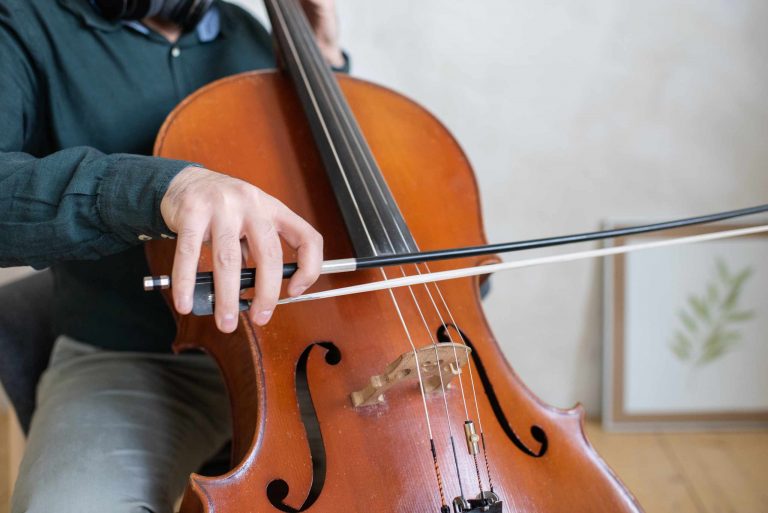
Take a break from the left hand for a moment and just bow the four open strings. It might seem silly, particularly if you’re anxious to start playing music, but this step takes one challenge out of the equation. Since there are no left-hand fingers to worry about, we can focus on the bow: where it meets the string, the speed of the bow, the amount of weight being applied to the bow hair, and what happens at bow reversals. Select the D string and draw a slow stroke in the middle of the bow. Can you hear if the tone sounds the same from start to finish? Does it get scratchy? If so, perhaps you’re pushing too hard, or your bow is drifting toward the bridge. Is the tone getting thin and wispy? Did the bow shift toward the fingerboard or lose some bow contact? Do a shorter stroke so that you can hear the tone without getting tired reaching to the frog or the tip.
Bow strokes on the open strings can help you learn to navigate your bow across the strings. Each string is a different height, so the bow arm must be adjusted. We shouldn’t raise our shoulders suddenly when we go from D to A, and we shouldn’t collapse our upper body when we go toward G or C. Switch back and forth between two adjacent strings with slow strokes. Try to make the movement subtle, and listen to the moment you transition from one string to another. Clean bow crossings tend to be produced by a smooth arm-level adjustment, rather than a big change of position with the wrist or shoulder.
After your bow path becomes steady, change one thing at a time. Use a slightly faster bow speed while keeping the contact point the same, then return to your original pace. Add a touch more weight to the bow hair (without clamping down on the frog). Shift your contact point a little bit closer to the bridge, and hear how it feels. Too many simultaneous variables make it hard to figure out what caused the change in tone, so try to isolate the variable so that you can understand which bow change led to your desired effect.
This exercise is especially good if you tend to let the left hand take over and ignore the bow. Beginners may be so busy looking for the first-position notes that they aren’t noticing inconsistencies in bow direction, pressure, and string crossings. Isolating the two hands for a portion of the practice allows the bow arm to practice its movements separately. When you pick up the left hand again to stop a note, you aren’t demanding that both hands deal with everything simultaneously.
To finish up, play a few open-string strokes and listen carefully without watching the bow. Can you hear an even tone, clean bow reversals, and no accidental touches to adjacent strings? Now watch your bow and see if it sounds the way it looks. The goal here isn’t to make open strings sound pretty. It’s to be able to identify what your bow is doing, so that when the left hand comes back into play, you don’t have to think quite as hard to control the sound.